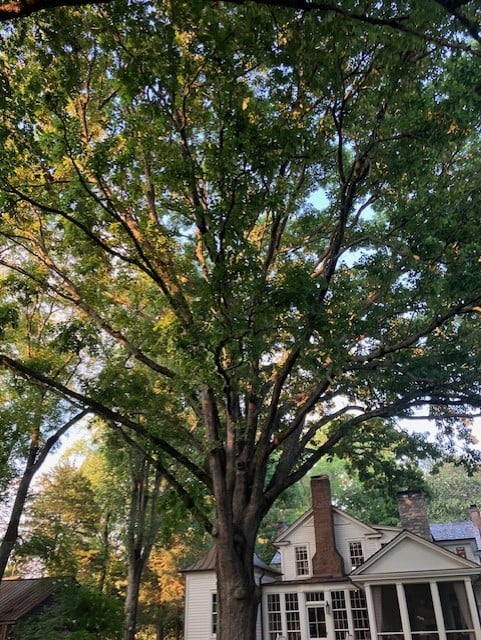
Quercus macrocarpa
Old Town was a large Mississippian Indian town with earthen pyramids, burial mounds and defensive earthworks. Local folklore has it that the natives called it “Old Town” when the Europeans arrived around 1780.
The Bur Oak was dated by professional arborists to be planted around 1870-1876 and perhaps to celebrate the nation’s centennial in 1876. The tree stands near the ancient pathway known as Natchez Trace and was used by native Americans for centuries and the US Army began working on the road in 1801 after President Jefferson secured treaties with the Chickasaw and Choctaw nations. Later, Andrew Jackson’s soldiers returning from the Battle of New Orleans used the road in 1815. Later still, President Jackson designated the Natchez Trace as a national post road for mail delivery from Nashville to Natchez, Mississippi.
The tree stands on the Old Town Plantation, once owned by John Donelson, Sr., one of the founders of Nashville. Thomas Brown later gained the land in 1846 and build a 2-story Greek Revival home overlooking the Harpeth River. Old Town was listed on the National Register of Historic Places for the Thomas Brown House and the Old Town Bridge in 1988.
In 2013 the land was saved from development from the Williamson County Highway Department when a newly organized Citizens for Old Natchez Trace secured protection and preservation of the historic 4.1-mile original roadbed of the 1801 Nachez Trace, including the Old Town Bur Oak.
Senator Bill and Tracy Frist purchased Old Town in 2015 and have been exceptionally gracious stewards of the legendary historic property. They also have a TUFC certified arboretum on their property. The Bur Oak stands as a centerpiece to this historic property and is 174 inches in circumference with an average crown spread of 106 feet.
Nominated by Laura Turner of the Citizens for Old Natchez Trace