

Webinar | From local actions to global impacts: how healthy urban forests support tree diversity
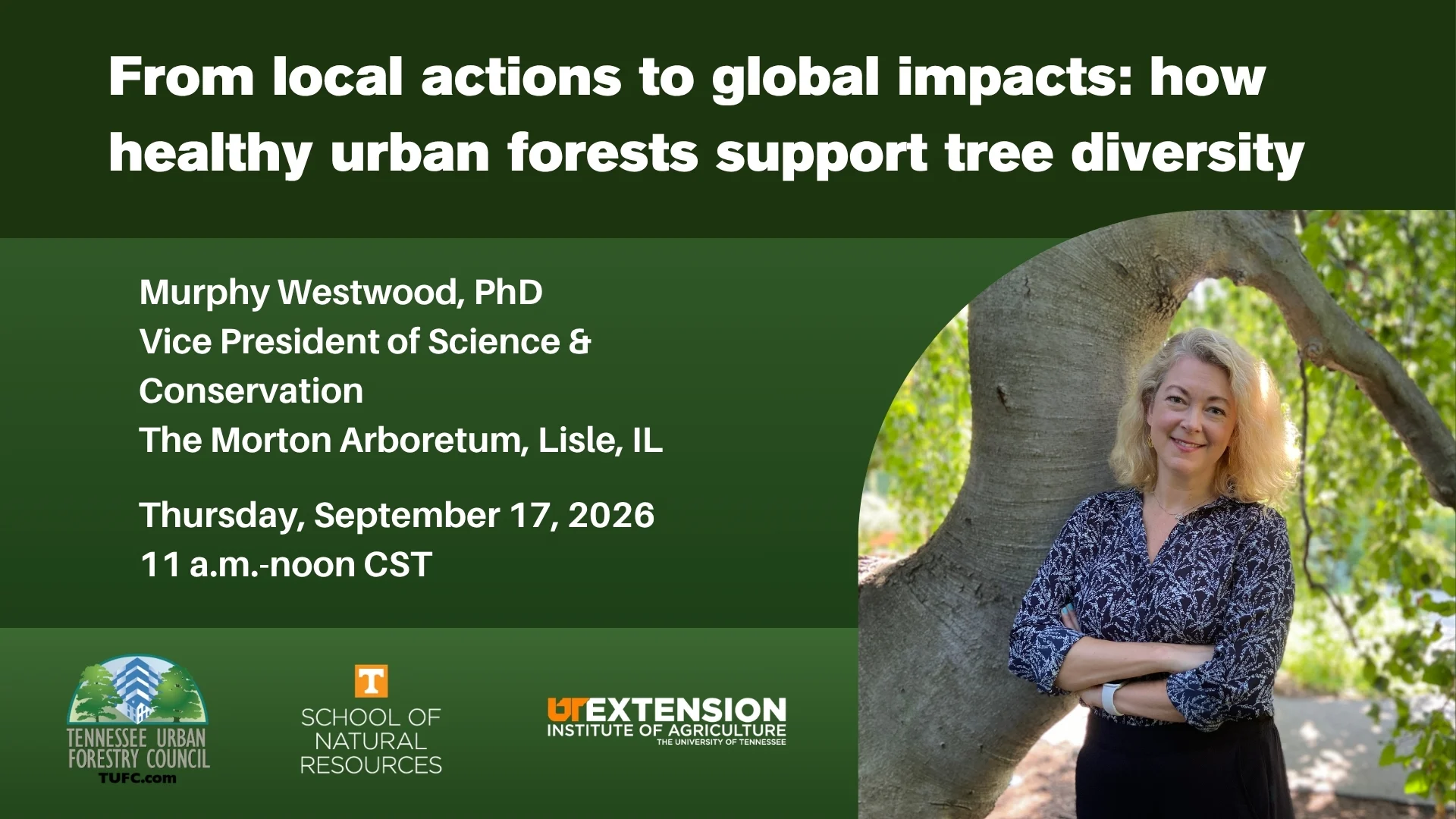
Please join us Thursday, September 17, for a webinar brought to you by the Tennessee Urban Forestry Council (TUFC) and the UT Residential and Community Forestry Workgroup!
From local actions to global impacts: how healthy urban forests support tree diversity
Thursday, September 17, 2026
11 a.m. Central / 12 p.m. Eastern
Preview
Urban and suburban areas can often feel disconnected and out of harmony with undisturbed forests in remote wilderness locations. But the trees growing in these two disparate settings are more connected than they may seem. Urban forests contribute significant benefits to support human health and biodiversity, and actions taken in our communities can improve the state of trees and forests nationally and around the world.. Understanding the current state of tree diversity within the United States is imperative to protecting those species, their habitats, and the countless communities they support, as well as the ecosystem services they provide in natural areas and the built environment. Despite the U.S. having ample resources and a relatively well-studied flora, before 2022 there was not a universally recognized, up-to-date, comprehensive checklist of U.S. tree species based on the standard definition of a tree for the Global Tree Assessment initiative, nor were U.S. trees well represented on the International Union for Conservation of Nature (IUCN) Red List of Threatened Species. Through a collaborative, cross-sector partnership including botanical gardens, nonprofits, and government agencies, we created the first comprehensive synthesis and assessment of the risk of extinction of the 881 tree species native to the contiguous United States. The most serious threats facing our native trees today are relevant in both urban and wild settings: invasive pests and diseases, climate change and severe weather, and loss of natural habitat. Fortunately, there are actions we can take to conserve and enhance our urban forests that have a positive impact on trees and ecosystems across the country, and can contribute to safeguarding the 11-16% of U.S. tree species that are threatened with extinction.
Attendees will learn about the current state of extinction risk of native US trees, and discover innovative initiatives in urban forestry and community engagement that are securing the future of trees.
Speaker:
Murphy Westwood, PhD
Vice President of Science & Conservation
The Morton Arboretum
Dr. Murphy Westwood is Vice President of Science and Conservation at The Morton Arboretum, where she leads programs advancing tree science, urban forestry, global tree conservation, and collaboration among arboreta worldwide. She oversees a team of scientists and conservation practitioners whose work includes the Center for Tree Science, Chicago Region Trees Initiative, Global Tree Conservation Program, Herbarium, and ArbNet. With more than 20 years of experience in plant biology, evolution, and conservation, Murphy has published more than 50 articles and reports and presented her work internationally. She holds a PhD in Plant Developmental Biology from the University of Cambridge, an MS in Advanced Methods in Taxonomy and Biodiversity from Imperial College London, and a BS in Environmental Policy and Behavior from the University of Michigan,
Continuing Education:
1.0 ISA CEU Submitted for Approval